

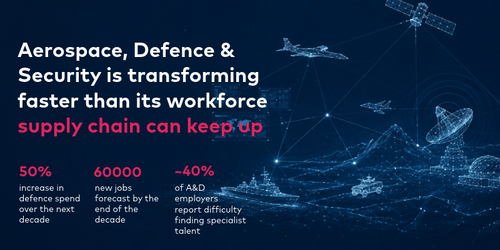



The aerospace, defence and security (AD&S) sectors have been facing a worsening skills shortage for some time, which is only set to grow with use of AI and technology and a generation of experience set to retire. A lot of the talent needed does exist, but in other sectors. Our latest research says plenty of people are open to changing sectors, but many have ruled defence out, primarily due to entry barriers.
Of the 300 UK technology and engineering professionals surveyed, 49% would consider aerospace and defence a sector of interest with it scoring 8.42 out of 10 for attractiveness on average.
Clearance as a leading blocker
Despite this sounding like good news, when asked what was holding them back, 24% named security clearance as the main reason they would not consider a career in these sectors. 30% stated that they don’t know enough about the sector to consider it.
Those numbers essentially show there are seriously needed workers who like the idea of the defence sector but talk themselves out of applying.
From the candidate's side it still looks like a locked door, however the key sits with defence employers.
If AD&S organisations recruit people who already hold active clearance, they are competing for the smallest pool in the market, alongside every other supplier on the same programmes. Cleared candidates are in demand because there are so few of them, and UK defence investment is pushing up demand for engineering, digital, data and technical skills every year. That is set to get more and more expensive.
Our research points to a much larger pool. 80% of the transferable talent we identified has never worked in aerospace and defence, and 83% have considered changing industries. They sit in telecoms, automotive, energy, rail, software and financial services, and many already work in regulated environments where process and audit are normal.
Sponsorship widens that pool. Each person that you clear and convert is capacity you own, rather than capacity you buy on the open market at a premium.
Senior Recruitment Manager Gary Wale works with organisations in regulated industries where cybersecurity and technology roles are challenging to fill, and overcoming misinformation amongst candidates around clearance is high on his list of priorities.
"Some of the best cybersecurity candidates I speak to have quietly ruled defence out because of a couple of letters on an advert. They see 'SC clearance' and assume it means years of government experience, so they scroll on without ever finding out how it works.
When I explain that the employer sponsors the clearance and that you don’t need a defence background to get it, the reaction is almost always relief, followed pretty quickly by curiosity. The employers who do this well say it plainly in the advert and look at how someone works and how fast they pick things up, rather than just where they’ve worked before. That’s what turns a tiny, cleared pool into a much bigger conversation."
How to act on this now
-
Sponsor earlier. Where the role allows, start the clearance process as soon as a candidate accepts, so the wait overlaps with onboarding and training instead of sitting as dead time.
-
Rewrite the advert. "Active SC essential" ends the conversation for most people. "SC required – sponsorship available" keeps it going. Where a role truly needs someone already cleared say so clearly but if there is capacity to provide clearance for someone interested in a sector move, make that obvious too.
-
Explain the process in plain language. Who sponsors, how long it takes, what the residency rules are, and what happens if the answer is no. If nearly a third of candidates are saying they don't know enough, the creation of one clear page on a careers site could close that gap.
-
Assess adjacency. Test technical skill, experience in regulated environments and how quickly someone learns, rather than only whether they have worked in defence.
There are obviously costs and risks in all of this. Sponsorship takes money and time, and not every clearance application succeeds. A pipeline spreads that risk across many candidates, and a conversion programme with training attached turns a gamble on one hire into a repeatable process.
Clearance should be a gateway to critical talent, not a reason to turn it away. The organisations that sponsor potential now will build the skilled, secure workforce defence needs for the future.
Ready for more data on how to unlock aerospace, defence and security’s hidden talent pool?